

The Skullball Legendary Cup is an event engaging two opposing teams in timed matches.
These official rules govern all competitions bearing the Skullball Legendary Cup brand. They have been designed to ensure the stability, continuity, and integrity of the competition. Every moment of this competition is to be enjoyed. Adherence to all the rules is mandatory. In this regard, participants agree to always conduct themselves in accordance with the best practices of this competition. The organizing team reserves the right to penalize any behavior that violates the following rules.
Game organization
Location
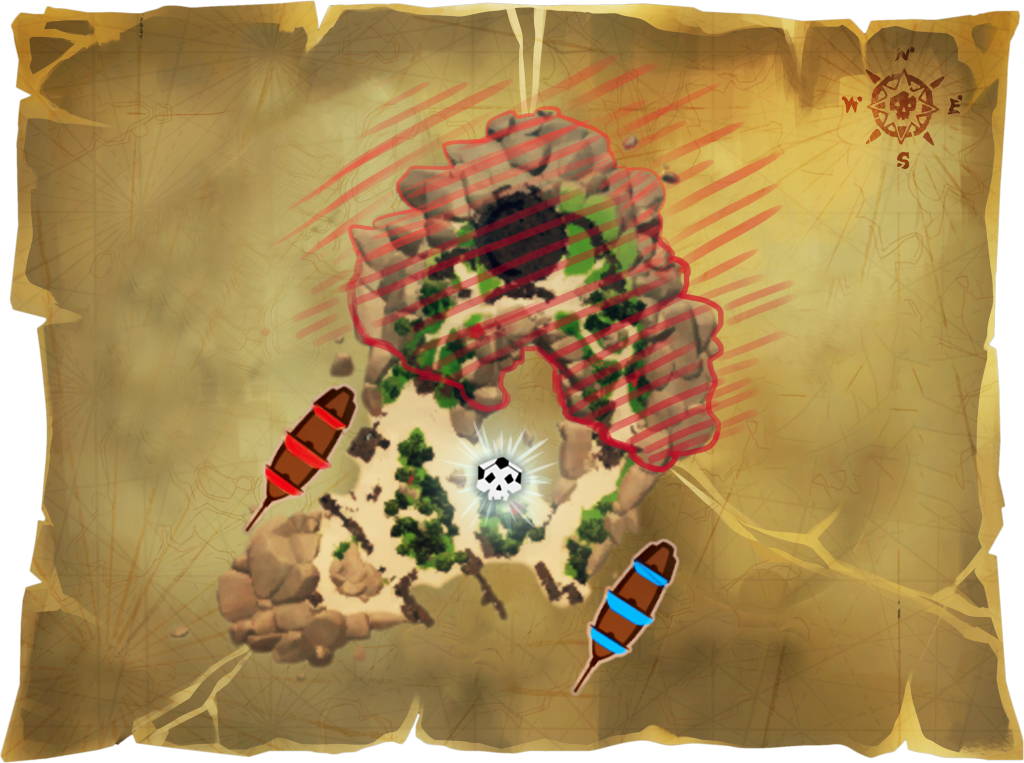
- Ships are placed by the organization on both flanks of « Hidden Spring Keep » fortress at i8.
- Ships must be placed as shown on the following figure.
- The blue team is placed at the East-side of the island, and the red team is placed at the West-side.
- The North-side of the island is out-ouf-bound for players. This area is marked with the red dashed on the figure.
- Sails of each ships must be folded and stay perpendicular to the ship.
- Crews start on the deck of their ship.

The skull
- The skull used for the SLC competitions is the Skull of Captain Douglas. Available in the Shores of Gold Tall Tale 8.
- At the start of each match, the skull is placed by the referees close to the central pool of the fort. More precisely, on the small edge at the bottom of the pool where it can be placed on the ground. Crews start on the deck of their respective ship.
- The crew that suffers a point regains possession of the skull before engagement.
- In the event of the skull glitched or stuck on the ship, a time-out is called and both teams must go back to their ship. Referees will place a new skull on the ship where the original one has been glitched or stuck.
- In the event of the skull glitched or stuck on the island, a time-out is called and both teams must go back to their ship. Referees will place a new skull at the start position (at the center of the island).
Point allocation and victory conditions
- A point is awarded to the team that places the skull in the opposing team’s crow’s nest.
- When a point is scored, the skull is put back into play on the ship of the team that suffered the point.
- Championship: In the event of a tie at the end of the allotted time, the final result is registered.
- Final phases: In the event of a tie at the end of the allotted time, a “Sudden Death” round is played (see below).
Round structure
- The main referee, located close to an island cannon, ask the teams if they are ready.
- When teams are ready, referees start the game.
- Kick-off is announced by a cannon shot from the referees.
- A match lasts 2 halves of 10 minutes each. At each half, teams exchange ships.
- If time is up and the skull is on one of the ships, then the action continues until the skull is carried to the top of the lookout or thrown off the ship.
- When a point is scored, the match is briefly interrupted so that crews can return to their respective ships to resupply.
Switching ships
- At the end of the first period, teams switch sides.
- The switch is supervised by the referees with the Custom Seas tools.
- As long as teams are incomplete, the match cannot start again.
Sudden Death
- A 3 minute timer is set. Sudden Death cannot exceed three minutes.
- The skull returns at the center of the island at the start of the round.
- At the start of the Sudden Death, all players must get off their ship and are forbidden to reenter them. Health and ammo are restored.
- Players only have one life. It is possible to revive a downed teammate but in the event of death they cannot return from the Ferry of the damned.
- The team that holds the skull at the end of the timer or whom at least one player is still alive wins the match.
- The available playing ground on the island is smaller, as shown on the next figure.
- Empty player inventory.
- Bonecallers cannot be used.
Food
- Food can only be consumed after each timeout after each goal. Never during the match.
- Barrels on the island must not be used.
- Referees ensure at the start of each match that there is no food in the players’ inventory.
Ship harpoons and zipline
- The island’s zipline can be used at any time of the game and by any player.
- Harpoon can be used during the game as a player movement support.
- Several cases prohibit the use of the harpoon: harpooning an ally or an enemy / moving the ship / harpooning the skull.
- Players can only walk on the enemy’s harpoon line. It is forbidden to modify its position, but it is allowed to shoot it for resetting.
Players
Selection
- Teams are responsible for their players registered before the start of a SLC Season.
- Each player is verified by the moderation and administration SLC teams.
- A player who has a SoTFR moderation record cannot be registered. The team who entered such a player will not be selected.
- Only the registered and accepted players are allowed to play. No additional player cannot be registered after the acceptance of the team application.
Number of players
- All matches are played by 2 teams of 4 players.
- Each team must have a maximum of 6 players.
- All the registered players can play a SLC match.
- A playing team with 3 players or less cannot participate and is declared ‘forfeit’ for the match.
- If the two playing teams both have 3 players, both teams are declared ‘forfeit’ for the match.
- Exception: during the finales, if both teams have the same number of players, they can play but no additional players will be able to join during play.
- If a player is late, a 10 minutes wait after the starting time will be tolerated. After this time, the team will be declared ‘forfeit’.
Captainship
- Each team must designate 1 Captain.
- If the Captain is absent, another player from the team can assume the role temporarily.
- The Captain represents the team when interacting with the SLC organization teams.
- Only the Captain may make a claim to the referees.
Replacing players
- Each team have 1 or 2 replacing players.
- No unregistered player can act as replacing player.
- Player changes may only be done between matchs.
Player classes
- Each player will choose one ‘class’ for the match. The following are available:
- Gunslinger: Blunderbuss + pistol or double-barrel pistol
- Swordmaster: Cutlass + throwing knives
- Trickster: blowpipe + cutlass or throwing knives or harpoon gun + 2 traps per match + 1 bonecaller
- Sharpshooter: eye of reach + cutlass or harpoon gun
- Jack of all trades: pistol or double-barrel pistol + cutlass or throwing knives or harpoon gun
- Players must choose only one class for the whole match, no changes are allowed at any time.
- Players within a team cannot choose the same class, except for the Jack of all trades which can be chosen by two players.
- Only the Trickster can use traps and bonecallers.
- No players are allowed to interact with traps, allied or from the enemy.
- Reloading ammunitions is only possible on the team’s ship. It is forbidden to use ammunition crates on the island or aboard the enemy’s ship.
- Players can use knifes found on the island.
Outfits
- One clothing set used by each player of the team is obligatory. In the event of a similar outfit during a match, players adapt if necessary.
- “Ghostly” elements should be excluded from your outfits, such as the Athena emissary costume and allegiance curses. Fluo colors are reserved for referees.
Stream
- Each player must broadcast their play on Twitch.
- A minimum stream of 480p and 60fps is required for all participants.
- Players cannot be muted on their stream.
- Players are responsible for their speech and actions, and they can be judged by the moderation team if the SoTFR rules are not respected.
- Streams must be functional before the start of a match, referees may ask to replace a player if required.
- Each player must be able to send a replay of the stream to the referees if asked, with all sound sources on.

Refereeing
Role of referees
- A match is set under the supervision of a referee who has all the necessary authority to enforce the rules of SLC.
- Referees are in-game players using the freecam mode to move freely on the field and follow players and the skull.
Decisions of referees
- The referees make decisions according to the situation, following the SLC rules and the spirit of competition.
- Appropriate decisions are based on the referee’s perspective.
- Decisions from referees and all SLC officials must always be followed.
Powers of referees
- Referees:
- enforce the SLC rules ;
- supervise the match with other referees ;
- take care of the match timer ;
- log every match events, disciplinary measures along with every incidents before, during and after the match.
- Referees can move the skull as soon as its position is judged to be inconvenient for the continuity of the match (e.g. invisible, blocked, buried).
- In the event that the skull is particularly difficult to find, referee may slightly move the position of the skull so that the match continues.
- Referees can ask a team to resume offensive play or to leave their ship if they abuse their defensive position for too long.
- Referees can decide to exclude a player or a team from the tournament as a result of behavior and attitude.
- Referees must communicate any relevant material to the SoTFR moderation team.
- In the event of any violation from the SLC rules, referees can give yellow cards (warning) and red cards (see Section IV).
Outfit for referees
- All referees must have the same outfit.
- Accepted outfit are : Soulflame captain costume.
Warnings and sanctions
Referees can issue yellow or red cards depending on the severity of the infraction. These sanctions are assigned on a case-by-case basis.
As part of the evolutive system of sanctions, once a yellow card has been issued to a player or team, a verbal warning is no longer possible for the remainder of the match.
Verbal Warning
- Referees can issue a verbal warning to a player or an entire team. This warning is considered a deterrent and not a yellow card. This allows for greater flexibility in refereeing.
- The reasons for a verbal warning are at the discretion of the on-field referees.
Yellow card
- A minor infraction that has not resulted in a clear disadvantage is sanctioned with a yellow card.
- The yellow card is retained until the end of the SLC Season.
- A second yellow card results in a red card.
Red card
- A serious or repeated infraction that has had decisive consequences is sanctioned with a red card.
- The red card is used to send a player off the match.
- A player who receives a red card cannot be substituted for the remainder of the match.
- A player can receive a red card after two yellow cards or after a serious foul.
- A player who receives a red card is excluded from the current match. If the red card is given after two yellow cards, the player is excluded from the next two matches.
- In subsequent matches, the sanctioned player can be substituted.
Game facts
- Teams freely establish their strategic composition (defense/attack).
- At the start of a round, only one team member can freely decide whether or not to stay on the ship to defend it.
- It is permitted to get back on the team’s ship.
- It is forbidden for several players to defend on board their ship for several minutes. The offensive is strongly encouraged.
- Exception: when the team is in a defensive phase and must protect its ship from an opposing assault.
- When a player is down, reviving is allowed.
- It is forbidden to swim behind the fort or pass behind it on the rocks.
- It is forbidden to climb to your own crow’s nest and sails.
- It is forbidden to use the ship’s cannons.
- It is forbidden to go to the lower decks of the opposing ship.
- It is forbidden to put throwing knives on your own rack or on the ladders of your ship.
- It is forbidden to use the “drop/catch” technique with the skull to increase your movement speed.
Championship’s organization
Schedule
- The championship takes place every Sunday at 3:30 PM (start of the first matches). All matches will take place over a period of 4 weeks.
- The forth Sunday will include Play-offs to determine the winner of the Championship.
- If a team does not register for the next Season, its élo score will be reset.
- All registered teams must be present in their designated locker room at 3:00 PM for briefing with referees.
Set up of the championship matches
- All registered teams are divided into “sets” of 3 teams maximum. The number of matches is based on the number of teams present in the set (3 matches in total for 3 teams / 1 match for 2 teams)
- Sets are composed according to the general ranking of the teams and their élo score.
- Exception for the first day of the championship. As all élo scores are set to 1,000, a draw will occur to create the 4 match sets.
- If a championship day cannot be organized, referees will set other times during the week to play matches.
Calculation of points
- During a set day, each team faces the 2 opponents of its set. This takes the form of A/B; B/C; A/C.
- Victory = +3 points for the winners / Draw = +1 point for each team / Defeat = 0 points for the losers.
- Ranking of the set is therefore established in ascending order of the number of points:
- If there is a tie, ranking is refined according to the difference between goals scored and goals conceded.
- If there is still a tie, the refinement is done on the number of goals scored (the greatest number wins).
- If still tied, the refinement is based on the number of goals conceded (the smallest number wins).
Absence of a team
- In the event of the absence of a team, it is penalized in the general classification. To garantee élo score calculation, the opposing team is declared winner with a score of 0-0.
- If a team is absent, it gets penalized in the ranking. The longer the absence, the heavier the penality.
- If a team is absent in 3 of the 4 weeks of the championship, it automatically takes the last place in the championship.
- If a team is absent for the entire duration of a championship (4 weeks), it is removed from the ranking. During registration for the next Season, the organization team may not choose this team.
Final stages
Setup of the final stages
- Only the top 10 registered teams can participate in the Play-offs.
- The results are based on the élo score at the end of the 4-weeks championship.
Progress
- The final phases take place on Sunday afternoon at 3:45 PM (start of the first matches).
- The semi-finals and final are streamed by the official SoTFR official channel.
- Organization of the final phases matches are shown in the following image:

Awards
- Title ‘Champion du Skullball’ will be awarded to winners on the Events | SoTFR Discord server. This title is reset after each Season.
- Title “Vainqueur d’événement” is awarded to winners on all SoTFR Discord servers.
- Winners can choose between a selection of Affiliate Alliance in-game cosmetics.
Rules notes
- Referees must apply the rules in the “spirit of the game” to ensure that matches are played in a fair and safe environment.
- Everyone must respect referees and their decisions, remembering that they are human beings who can make mistakes and are volunteers who give their time to the community.
- Players have a huge responsibility for the image of the sport, and the team Captain must help ensure that the rules and the referee’s decisions are respected.
- No player can claim ignorance of the competition rules.
These rules may be modified by the SoTFR event organizers. Any changes will be communicated to all SoTFR teams and participants.
Spirit of the game
The term “spirit of the game” in the SLC rules refers to the set of fundamental values and principles that underpin the practice of Skullball.
These principles go beyond the technical rules of the game and include notions of fair play, respect, integrity, and sportsmanship. The spirit of the game is essential to maintaining the integrity of SLC and ensuring that Skullball remains an enjoyable and fair game for all participants.
Respect for the rules
- Players, coaches and referees must respect the rules of the game, which are designed to ensure fairness and the safety of all participants.
Respect for opponents and officials
- The spirit of the game implies mutual respect among players, for referees and for all participants in the match. This includes behaviors such as not seeking to exploit loopholes in the rules, not aggressively challenging the referee’s decisions and avoiding any form of provocation or insult.
Fair play
- Fair play is at the heart of the spirit of the game. It is a positive attitude and fair behavior, even in competition. Players must play in a positive manner, respecting the ethics of sport.
Players are encouraged to play fairly and accept victory or defeat with dignity, without seeking to exploit loopholes in the rules or abusing the game in a way that is contrary to the spirit of sportsmanship.
